How to become a rentier without the 4% rule with the dividend strategy?

In 1994, a financial advisor named Bill Bengen became famous for creating the 4% rule. It’s now the most recommended and widely used annuity and financial independence technique in the world. The concept is simple: each year, you can withdraw 4% of your stock portfolio to live as an annuitant, without ever running out of money until your death. This technique is widely used by many annuitants.
Today, we’ll look at why this rule is a scam, its hidden drawbacks, and the much better alternative.
A little teaser: the creator of this rule, a recently retired annuitant, has just announced that he no longer applies it himself.
How does this rule work, and why 4%?
You start investing €500 per month in the stock market starting at age 30. With an average return of 8% per year and thanks to compound interest, you reach retirement at the age of 64 with a stock account showing €1,000,000. Instead of being a jerk and withdrawing it all to buy a Porsche and a couple of other stupid things, you decide to apply the 4% rule. You keep your million invested and each year, you sell a portion of your stocks, ETFs, or bonds at 4%, or €40,000 to live off. Then you do this every year, adjusting for inflation each time. The amount withdrawn will probably always be different, but never the percentage. Because your million may go down or up depending on the stock market, but regardless, you’re always withdrawing 4%.
But why this 4% figure?
Bill Bengen, the creator of this rule, stated that he took two indicators into account when he created it in 1994. The first is that the market returns an average of 7% per year. The second is that inflation is 3% per year. So, to create his rule, he took the market’s return and subtracted inflation to create the amount you can safely withdraw from your portfolio each year while allowing it to regenerate until the next year. The idea is so simple and theoretically perfect that it quickly became the most recommended advice among wealth managers. But the irony is that Bill Bengen is now retired and has been able to practice what he preached throughout his life. And guess what? In a recent interview with the Wall Street Journal, he said that the rule actually wasn’t easy, that it put him in an uncomfortable situation in the current economy, and that he simply started breaking it. What is the best stock market investment strategy? – The Smart Investor

The article could end here, but that wouldn’t be fun. It’s interesting to see why this rule, although theoretically sound, isn’t actually suitable in practice, and what the ultimate alternative is. The first problem with the 4% rule is that it’s 30 years old. The conditions under which it was created are no longer the same as they are today. In 1994, bonds generated an annual return of 8%, and that rate has only declined since then, reaching virtually zero in 2020. The same goes for inflation, which is completely different today than it was 30 years ago.
The second problem is that the rule is based solely on long-term historical average returns. When you’re young and accumulating capital, that’s what interests you, but when you’re retired, you no longer have a long-term view but rather an annual one. While the stock market generates an average of 10% per year over the long term, over a shorter period, the stock market is very volatile.
This is particularly true when stocks are trading at relatively high valuations. When this is the case, short- and medium-term returns can be very disappointing. And this is exactly what we saw at the beginning of the year when the markets began to deflate after an incredible 2021.
It’s also what we saw during what is called the lost decade between 2000 and 2010, when the SP500’s 10-year return was -30%. All this to say that investors must be prepared for potentially low returns for several years and perhaps even sudden sharp corrections.
The Risks of the 4% Rule – DCA in Reverse!
If your portfolio drops by 50%, as it did during the crashes of 2000 and 2008, following the 4% rule means seeing a 50% reduction in your income compared to the previous year. Most annuitants and retirees simply don’t have a portfolio large enough for this 50% reduction in their income to allow them to continue living normally. Especially with significant and increasing fixed expenses like medical bills, grandchildren, housing, etc.
In this case, and to maintain the same level of income, you would be forced to withdraw much more, say 8%, which means selling at the worst possible time—at the bottom of a crash.
This damn rule forces you to sell more assets than you’ve bought while working your whole life due to short-term fluctuations at explosive prices. In short, the 4% rule is DCA in reverse. And doing DCA in reverse could very well result in a permanent loss of your capital and therefore your annuities.
The Big Problem with the 4% Strategy – The Smart Investor
The Biggest Risk for Annuitants

We’ve talked about the worst-case scenario with a stock market crash, but that doesn’t happen every day.
Absolutely, but people are living longer and longer, with pensions stretching out to 20, 30, or even 35 years. Over such a long period, there are bound to be crashes and prolonged bear markets. This is exactly what happened to the creator of the rule himself, who, after a few years in retirement, realized that he could not sustain it psychologically. The third, and in my opinion, most important, problem with the 4% rule is that it goes against the concept of generational wealth creation. To understand this concept, you need to know that there are two types of wealth:
Static wealth
Functional wealth.
- Static wealth
- Let’s imagine a piece of farmland. The land itself has a certain value, which can change over time but which you can only unlock if you sell it.
Functional wealth
Functional wealth is the value generated by what is planted on that farmland. This land can generate value, or income, year after year without needing to be sold. When you look at the history of the world’s richest families, they all did the same thing. They simply took the functional wealth generated by static wealth and put it to work buying even more static wealth.
In short, the incoming money was used to buy even more money generators, and so on. Simple, organic, and endlessly repetitive.
Ask yourself the right questions! Being a rentier is good, but anything else is even better!
Unfortunately, the 4% rule doesn’t do that at all. The 4% rule will instead encourage you to sell a piece of farmland every year to finance your life.
So we’ve gone from wealth creation to gradual wealth liquidation. Your children and those after will just have to figure it out.
So the questions are: is this how you want to live your financial independence? Is stressing about your money every time it drops a little the vision you had for your retirement by investing your whole life? Does nibbling away at your capital little by little to finance your life and probably leaving nothing as an inheritance appeal to you? I don’t think so. What’s the best alternative to the 4% rule? The new source of income – Dividends
Personally, I don’t want to find myself short of money at 70 because of the misfortune of a crash that came at the wrong time. I want a sustainable financial independence strategy, whether the market is up or down.
And above all, I don’t want to compromise my quality of life with income that fluctuates based on the value of my portfolio. That’s good. There’s a much better and older alternative to the 4% rule: passive income generated by dividends.
The concept is simple: each year, you know exactly how much you’ll receive, allowing you to reinvest a portion and live off the rest without any regrets. And since you don’t sell anything, each year you hold slightly more shares than the previous year, which generates even more passive income. Let’s see why this annuity technique is superior to the 4% rule.
Dividends Allow You to Create an Income for Your Future – The Smart Investor
Practicing the Dividend Rule to Become an Annuity Holder
In 2008, a financial advisor named Jack Gardner conducted a study in which he discovered something incredible. Between 1968 and 2007, investing in the 100 largest dividend-paying stocks in the SP500 generated an average return of 13.5% per year, while the SP500 only generated 10.5%.

While the dividend-paying stock portfolio in red is worth $1.5 million in 2007 with a total withdrawal of $444,000 over the eight years. Both portfolios started with the same value of $1 million and exactly the same amounts withdrawn each year.
But each went in a different direction. One is being nibbled away little by little. And the other continues to grow. This is the magic and incredible power of safe, conservative, and growing dividends that we are witnessing. How do rentiers implement a dividend strategy?
Thanks to dividend-paying stocks like Total Energies and Verizon, investors can ignore many of the short-term risks that give headaches to renters of the 4% or 5% rule. This is exactly the objective of my PEA (Home Savings Plan), where I aim for a yield on cost between 3.5% and 4.5% per year, with an average annual dividend increase above inflation and a steady capital appreciation that’s less volatile than the markets.
And in the short term, the stocks I choose have stable dividends and often increase annually regardless of the macroeconomic situation. Few of the companies in my portfolio cut their dividends in 2008 and 2020.
Remember that as long as a company’s dividend remains secure (and growing) thanks to a solid balance sheet and sufficient cash flow, short-term stock price volatility doesn’t really matter. Unlike annuitants with the 4% rule. Even better, since my portfolio generates passive money, I can take advantage of it to reinvest a portion during crashes to take advantage of opportunities that will generate even more passive money.
A dividend strategy can have problems – The Smart Investor
The problems with a dividend strategy
But to be completely honest, we still need to present the two problems posed by the dividend-based annuity alternative.
Problem 1: Lack of time to build your portfolio
First, for this strategy to work, you need to start investing as soon as possible before your retirement or financial independence date.
If you start investing 10 years before retirement, the power of compound interest may not have enough time to grow your portfolio to the point where you can
exclusively rely on it for your pensions.

Second potential problem: dividend cuts. If we take the example of Walt Disney, we can clearly see how the company abruptly suspended its dividend in 2020 and has been doing so for three years. No one knows when the company will resume it, and three years alone is already a long time for an annuitant who depends on it.
Diversify your stocks to compensate for dividend cuts
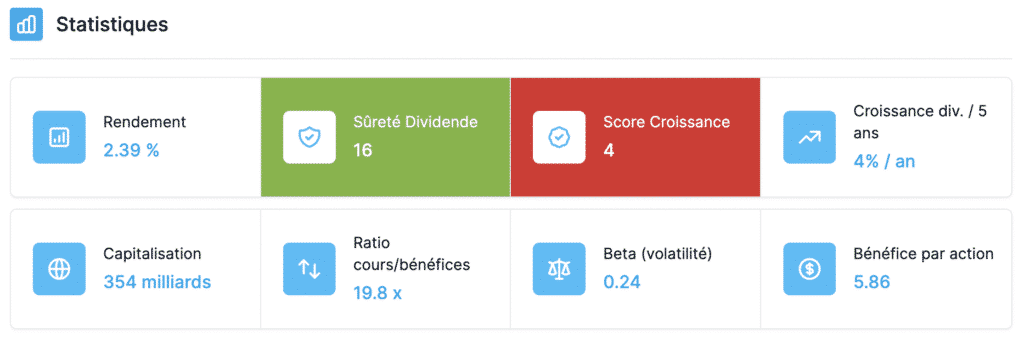
This is why diversification is important, especially the dividend safety score offered by Moning, which, for each stock, the Moning platform will provide a score out of 20 to assess the risk of a dividend cut during the current economic cycle.
MONING platform statistics for Nestlé stock – The Smart Investor
Two techniques that significantly reduce the risk and impact of a dividend cut on pensions. But you should know that in the stock market, nothing is ever guaranteed, whether it’s the 4% strategy or the dividend strategy. Of course, each investor has their own preferred strategy. Being a rentier depends on each individual’s personality.
If you’re keen to start investing and grow your dividend portfolio, I recommend the commission-free broker Trade Republic to open a securities account. With Trade République, by registering with a link, you’ll earn a free share worth up to €200! If you’d like to open a PEA (Share Savings Plan), I recommend Bourse Direct. By registering with my link, you’ll receive a €50 bonus when you open your account.

Articles similaires

Emprunter pour investissement locatif : mode d’emploi 2026
Comment emprunter pour un investissement locatif ? Guides, taux 2026, capacité d’emprunt, prêts sans apport et critères bancaires expliqués.
Make your first euros with Pepperstone
The world of trading is attracting more and more curious people looking for additional income or profitable investments. Getting started in the…

How to invest in DCA intelligently?
Dollar-cost averaging is a mechanical method of investing. It smooths out costs and minimizes volatility. It can be a powerful tool for…